The Dialects
An introduction to the spoken varieties of Arabic — and to the formal register that sits above them all.
The first question every Arabic learner faces, often before they realize they are facing it, is which Arabic. The textbook may not pose the question. The course may quietly settle it for the learner by teaching one variety without naming the others. But the question is real, and it does not go away. The Arabic spoken in Cairo is not the Arabic spoken in Casablanca, and the Arabic spoken in Beirut is not the Arabic spoken in Baghdad. There is a formal register, al-fuṣḥā, that sits above all of them — the language of news broadcasts, of books, of religious recitation — but no one speaks it at home, no one orders coffee in it, no one argues with their brother in it. In daily life, what people speak is one of the regional varieties, and learning Arabic in any meaningful sense means choosing among them.
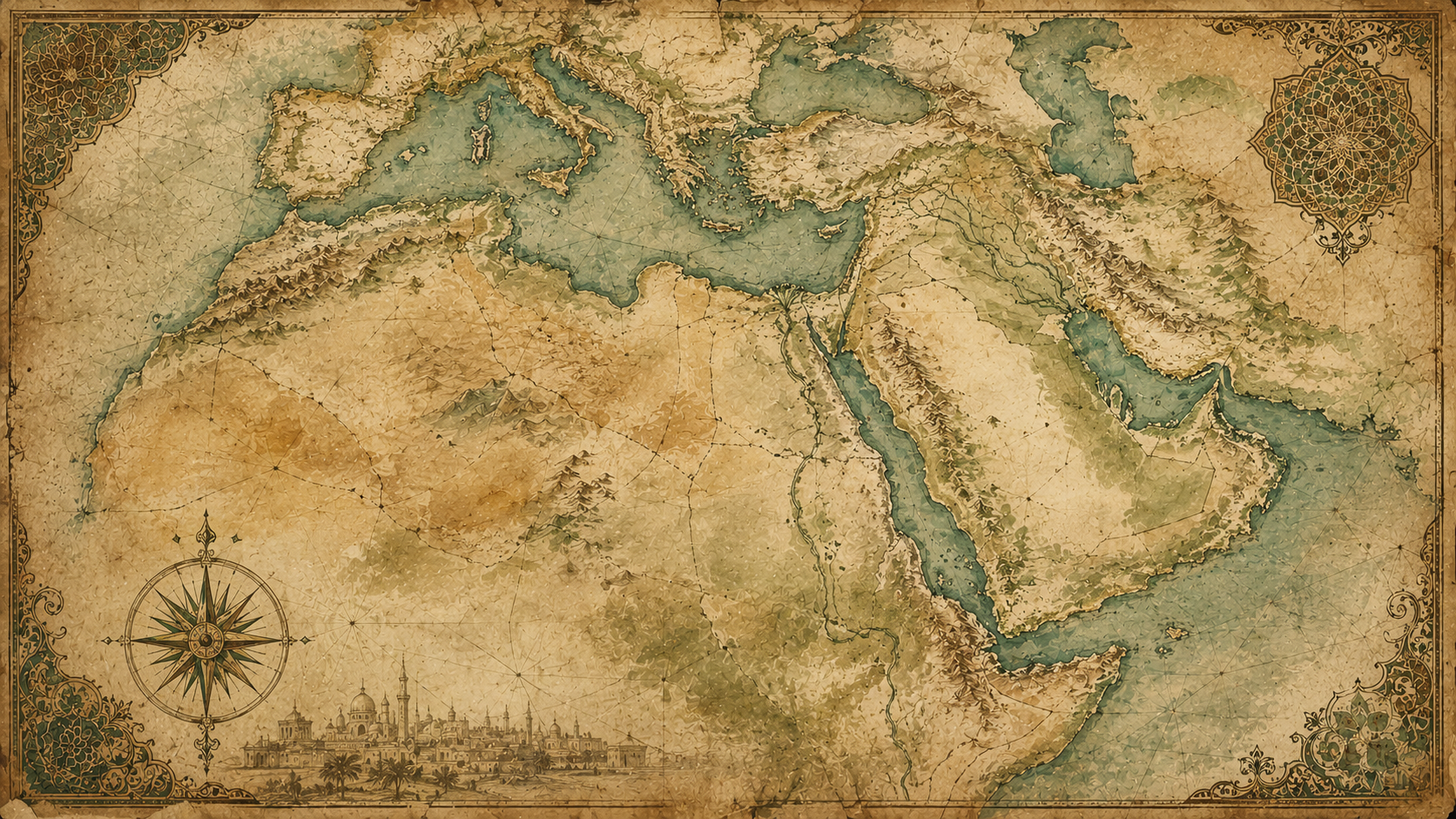
This page is a map. It introduces each major variety, what makes it distinctive, where it is spoken, where it is encountered, and who tends to learn it. The deeper studies of each — the histories, the grammars, the cultural worlds — belong to the individual articles, which will appear here over time and link back to this overview. The map itself is the starting point.
A Note on Terminology
A few terms repeat across the entries below, and it is worth defining them once.
Al-fuṣḥā — literally "the most eloquent" — is the formal register of Arabic. In modern usage it most often refers to Modern Standard Arabic (MSA), the language of news, formal writing, and educated public speech across the Arab world. Al-fuṣḥā descends directly from the Classical Arabic of the Quran and early Islamic literature, modernized in vocabulary but preserved in much of its grammar.
Al-ʿāmmiyya — literally "the common" — is the umbrella term for the spoken vernaculars. There is no single al-ʿāmmiyya; there are many. Each region has its own, with its own pronunciation, vocabulary, and grammatical shortcuts.
The relationship between al-fuṣḥā and al-ʿāmmiyya is what linguists call diglossia — a stable arrangement in which two related but distinct varieties of a language coexist in the same community, each used in different contexts. Al-fuṣḥā is for the page, the pulpit, the broadcast. Al-ʿāmmiyya is for everything else.
This distinction matters because it determines what kind of Arabic the learner ends up speaking. A course taught entirely in al-fuṣḥā will produce a learner who can read the news but who sounds strange ordering a meal. A course taught in a single ʿāmmiyya will produce a learner who can speak comfortably in one country but will have to adjust the ear in others. The practical answer for most learners is to begin with one, and to know that the other exists.
Modern Standard Arabic (al-fuṣḥā)
Modern Standard Arabic is the language of the public sphere across the Arab world. Newspapers are written in it. Television news is broadcast in it. Books are published in it. Speeches at international conferences are delivered in it. Classical Arabic poetry was composed in its older form, and the Quran is recited in a register from which it directly descends.
No one is a native speaker of Modern Standard Arabic in the way someone is a native speaker of Egyptian or Levantine. Children grow up speaking their regional variety at home and encounter al-fuṣḥā primarily in school, in religious settings, and in formal media. A learner who masters al-fuṣḥā will be able to read across the Arab world, follow formal broadcasts in any country, and write to almost any educated reader. They will also sound conspicuous in casual conversation — formal in a way that no native speaker would actually be, the equivalent of someone in English using only the register of a parliamentary speech.
For learners whose primary purpose is reading — Arabic literature, classical poetry, the Quran, journalism, academic writing — al-fuṣḥā is the right place to begin. For learners whose purpose is speaking with people in their daily lives, al-fuṣḥā alone is not enough.
Egyptian Arabic (Maṣrī)
Egyptian Arabic is the most widely understood spoken variety in the Arab world, not because it has the most speakers — though Egypt's population of more than a hundred million does make it the largest single national variety — but because of Egypt's twentieth-century cultural reach. For most of the twentieth century, the films, the music, and the comedies that traveled across the Arab world were Egyptian. A Moroccan and a Syrian who do not understand each other in their own dialects can often meet in Egyptian, simply because both have grown up watching it on television.
The Cairo variety is the prestige form, and it is the Egyptian Arabic most courses teach. Its most recognizable feature is the pronunciation of the Arabic letter jīm — which in most dialects is pronounced as the consonant in English jam — as a hard /g/. This is why Egyptians say Gamāl where Levantines would say Jamāl. The letter qāf in everyday Cairene speech tends to soften to a glottal stop, giving the dialect a distinctive rhythm.
Egyptian is generally the most pragmatic choice for a learner whose interests are broad rather than country-specific. A learner of Egyptian will be understood in most of the Arab world, will have access to a vast catalog of films and music, and will encounter an unusually rich body of teaching materials.
Levantine Arabic (Shāmī)
Levantine Arabic — Shāmī — is the variety spoken across Syria, Lebanon, Palestine, and Jordan. It is divided internally into Northern Levantine, which covers Syria and Lebanon, and Southern Levantine, which covers Palestine and Jordan. The differences are real but small, and a Lebanese speaker and a Jordanian speaker have no difficulty understanding each other.
Levantine has come, in the last several decades, to rival Egyptian in its media presence. The high-budget pan-Arab television dramas — the musalsalāt — are very often Syrian or Lebanese productions, and a generation of Arab viewers across the Gulf and North Africa has grown up watching them. Lebanese music — Fairuz above all — has carried Levantine into homes across the Arabic-speaking world for half a century.
The pronunciation is melodic. Qāf softens to a glottal stop in urban speech, as in Egyptian, though the rural dialects often preserve a harder pronunciation. Vowels are slightly more varied than in Egyptian, giving the dialect its characteristic music.
For learners interested in Lebanon, Syria, Palestine, or Jordan — or in the modern Arab cultural production that comes from these places — Levantine is the natural choice.
Gulf Arabic (Khalījī)
Gulf Arabic — Khalījī — covers the dialects spoken in Saudi Arabia, the United Arab Emirates, Kuwait, Qatar, Bahrain, and Oman. There is internal variation, and a careful linguist would distinguish Hejazi (western Saudi Arabia, around Mecca and Medina) from Najdi (central Saudi Arabia) and from the more eastern Gulf varieties. For the learner, Khalījī is a useful umbrella, and the dialects within it are largely mutually intelligible.
Several features set Khalījī apart from the Egyptian and Levantine of the eastern Mediterranean. Qāf is often preserved as /q/ or pronounced as a hard /g/, never softened to a glottal stop. The vocabulary draws on Persian, on Hindi-Urdu, and on regional trade languages reflecting centuries of contact across the Gulf and the Indian Ocean. The grammar in some respects sits closer to al-fuṣḥā than the dialects further west.
The Gulf has become an increasingly important center of Arabic media, business, and soft power in the twenty-first century, and Khalījī now reaches a wider audience than it once did. For learners with professional interests in the Gulf — and there are many — it is the obvious choice. For others, it is less commonly taught and less commonly heard outside its region.
Maghrebi Arabic (Darija)
Maghrebi Arabic — Darija — is the variety spoken across Morocco, Algeria, Tunisia, and Libya. It is, by some distance, the most distinct of the major spoken Arabics. Its vocabulary draws heavily on Berber (Tamazight), the indigenous languages of North Africa, and on French, the language of the colonial period, which remains a living presence in much of the region. Its vowels are often clipped, its consonant clusters denser, its rhythm faster.
The result is a variety that speakers of Eastern Arabic — Egyptian, Levantine, Gulf — frequently cannot understand without effort. The reverse is less true: Maghrebis grow up watching Egyptian and Levantine media and adjust easily to those dialects. But a Moroccan speaking Darija among other Moroccans is, to a Saudi or a Lebanese ear, often opaque.
This is the central practical fact about Maghrebi Arabic, and it shapes the learning calculus. Darija is the right choice for learners whose interests are firmly in Morocco, Algeria, Tunisia, or Libya — and in those regions, it is essential, because the local population uses Darija in everything from daily conversation to popular music. For learners with broader interests across the Arab world, Darija is less useful as a starting point, and Egyptian or Levantine will travel further.
Iraqi Arabic
Iraqi Arabic is spoken across Iraq and into adjacent regions of Iran, Syria, Turkey, and the Gulf. It is divided internally into the gilit dialect — spoken across central and southern Iraq, including Baghdad — and the qeltu dialect — spoken in Mosul and parts of the north. The names come from the way each pronounces the verb meaning "I said" — gilit in the south, qeltu in the north — and the difference is symptomatic of deeper divergences in pronunciation and vocabulary.
Iraqi has been shaped over millennia by contact with the languages that preceded it in Mesopotamia — Aramaic above all — and by long centuries of contact with Persian and Turkish during the Ottoman period. Its vocabulary preserves layers that no other Arabic dialect carries. Its sound is distinctive and recognizable.
For learners with interests in Iraq specifically, Iraqi is the right variety. Outside Iraq, it is less commonly taught, and learners typically arrive at it through prior fluency in another dialect rather than as a starting point.
Sudanese and Yemeni Arabic
Sudanese Arabic — spoken across Sudan and into South Sudan — has been shaped by sustained contact with the Nubian languages and other languages of the Nile Valley. Its pronunciation is distinctive, its vocabulary partly its own. It shares features with both Egyptian and the Arabian Peninsula varieties to the east.
Yemeni Arabic is among the most archaic of the spoken varieties — closer in some respects to the Classical Arabic of the early medieval period than any other contemporary dialect. It is internally diverse, with significant differences between coastal and highland speech. For learners with specific connections to Yemen, it is a remarkable variety. For most learners, it is encountered rather than chosen.
Both Sudanese and Yemeni reward the learner who arrives at them through curiosity rather than necessity, and both deserve their own articles, which will appear here in time.
How to Choose
There is no single right answer to the question of which Arabic to learn, and a learner who is told that there is should be cautious of the source. The right answer depends on what the learner wants to do.
For a learner whose interests are broad — Arabic media, travel across the Arab world, film and music, the experience of a language that reaches across many countries — Egyptian or Levantine are the most pragmatic starting points, with Egyptian holding a slight edge for sheer reach and Levantine for current cultural production.
For a learner whose interests are anchored in a specific country, the choice is the dialect of that country. Morocco asks for Darija. Saudi Arabia asks for Khalījī. Iraq asks for Iraqi. The learner who tries to substitute Egyptian for Moroccan in Casablanca will find themselves understood, in a measured way, but not really speaking the language of the place.
For a learner whose primary interest is reading — literature, the news, the Quran, classical Arabic poetry — al-fuṣḥā is the answer, and the spoken dialect can be acquired later, if at all.
The choice is not permanent. A learner who begins in Egyptian and later finds their life leading them to Beirut or to Riyadh will adjust. The dialects share enough that a foundation in one is a foundation that travels, even if it does not arrive intact. What matters is to choose with awareness — to know, when one begins, that there is a choice being made, and that the textbook's quiet assumption that "Arabic" is a single thing is a convenience that will not survive contact with the language as it is actually spoken.
This page will be updated as deep studies of each variety appear in the article feed. Each section above will, in time, link to its full piece — the histories that made each dialect what it is, the music and the cinema that carry them, the small and surprising features that reward attention. The map is the beginning. The territory is what the articles will explore.
— A.C. Maas