Arabic Voices 1 & 2: A Review
Every learner of Arabic eventually meets the same wall: the language of the textbook is not the language of the taxi driver. Lingualism's two-volume Arabic Voices refuses to choose between them. On the books that take Modern Standard Arabic and the spoken dialects equally seriously.

On the books that take Modern Standard Arabic and the spoken dialects equally seriously.
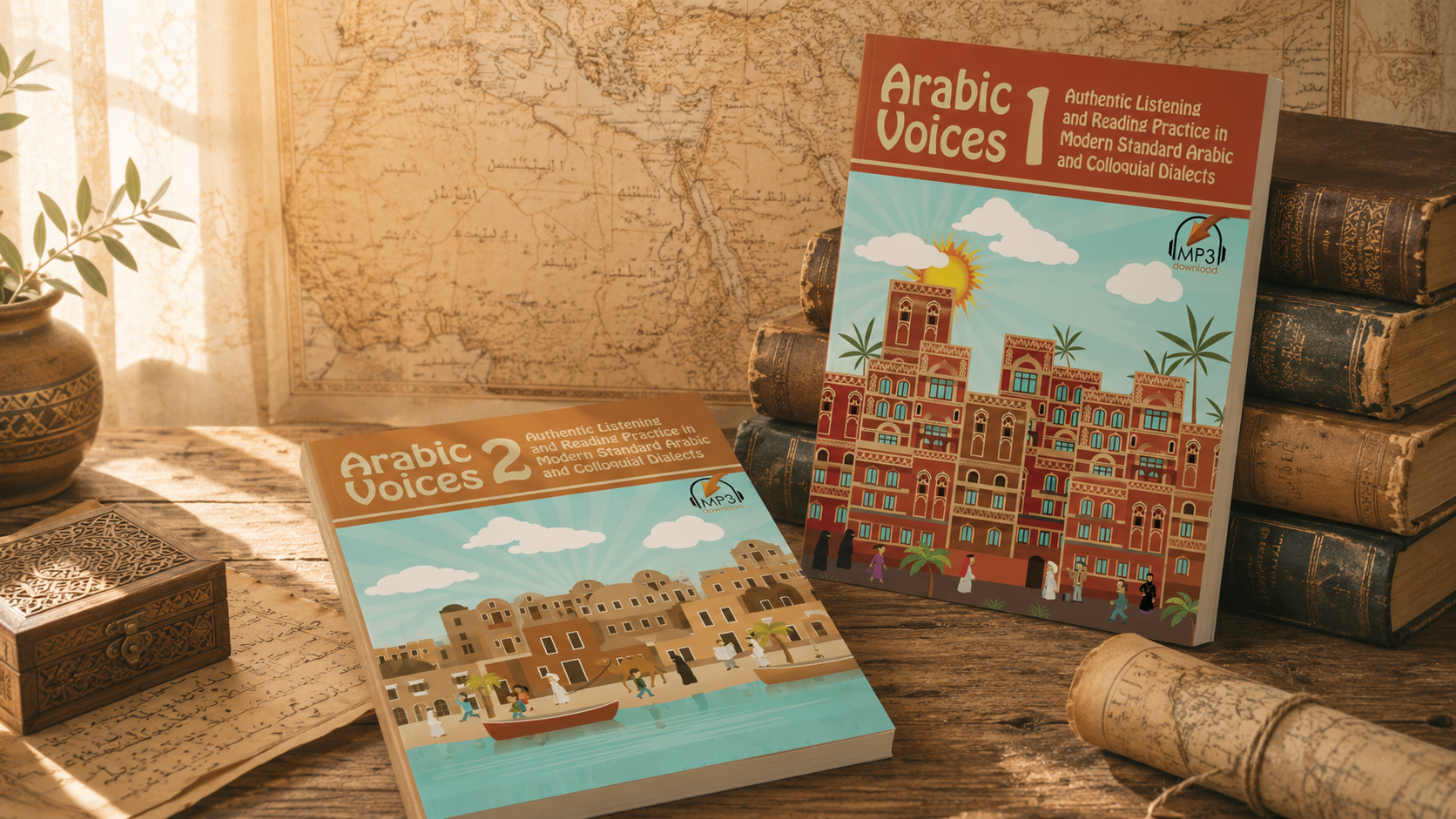
Every learner of Arabic eventually has the same realization. There is the Arabic of the textbook — grammatical, formal, voweled, the register of newscasters and Friday sermons and academic writing — and there is the Arabic of the airport taxi driver, the corner-shop owner, the friend's mother offering tea. The two share a script and a great deal of their vocabulary, but they are sufficiently distinct that a learner of three years can find themselves competent in the first and lost in the second. The publishing house Lingualism took a position on this problem more honest than most: do not choose. Teach both at once. The two volumes of Arabic Voices, published in 2014 and 2015 by the small editor Matthew Aldrich, do exactly that. The result is one of the more useful objects an intermediate or advanced learner of Arabic can find for sale.
The structure of the project is simple enough to describe. Twelve native speakers — from Morocco, Tunisia, Egypt (four of the twelve), Syria, Jordan, Lebanon, the Palestinian community in Israel, Iraq, and Yemen — were given topics and a microphone, and each was invited to contribute several short personal essays. Some chose to speak in MSA, the formal register most of them had learned in school. Others spoke in their native dialect — masry, shami, darija, yamani — using the language as it lives in their mouths, with all the irregularities that distinguish it from the standard. Across both volumes the result is fifty-four recorded essays, transcribed in full, accompanied by line-by-line English translations, listening exercises, vocabulary work, and grammatical focus boxes. The audio is available as a free download from lingualism.com and also streamable on YouTube.
What sets the resource apart, and what makes it earn its space on the shelf of a serious learner, is the editorial seriousness with which the publisher treats colloquial speech. In most Arabic instructional materials, the dialects appear, when they appear at all, as a footnote — a brief acknowledgment that something exists beyond MSA, a few greetings, perhaps a vocabulary list, and then back to the standard. Aldrich treats the dialects as a principal subject. They are transcribed in the Arabic script, fully voweled, with the same care given to MSA texts. When a dialect text is presented, the matching exercise that follows shows three columns rather than two — the dialect word, its MSA equivalent, and the English meaning — so that the learner can see, line by line, how the spoken form relates to the written one. The pedagogical claim built into this design is not that the dialect is a deviation. It is that the two are parallel registers of the same language, both of which a serious learner must eventually meet.
The methodology around the recordings rewards a particular kind of discipline. Aldrich's instructions, repeated across the introductions to both books, ask the learner to resist the obvious shortcut. Do not read the Arabic before working through the listening. Do not read the English before working through the Arabic. The exercises are sequenced — main idea, true or false, multiple choice, matching, then text and translation — to push the learner through layers of comprehension before granting the full text as a key. A "Focus" box appears in selected segments to draw attention to a particular grammatical feature: the negation patterns of Egyptian colloquial, the verb forms of Levantine, the distinctive consonant shifts of Moroccan. None of this is required. The audio and transcript alone are enough for a learner who wants only to listen. The scaffolding is there for those who want a more deliberate path.
Two design decisions deserve singling out. The first is the use of full taškīl — every short vowel, every consonant marker, made visible above and below the Arabic letters. This is rare in published Arabic of any kind. It is the convention of children's books and of Qur'anic editions, not of adult texts. The decision to apply it throughout these books treats the reader as a learner needing every signal the script can give, and it dramatically lowers the cognitive cost of reading the transcripts. The second is the publisher's faithful transcription of the speakers' own speech — including English code-switches, fillers, false starts, and self-corrections. When Luma, the Jordanian narrator, says in the middle of an Arabic sentence, "in shā' Allāh I'll have done a 'good job', as they say," the English words are printed in the Arabic text, in English, exactly where she said them. This is what bilingual Arab speech sounds like in the present. The book does not pretend otherwise.
The dialect coverage is broad in ambition and uneven in distribution. Egyptian colloquial is well represented; four of the twelve speakers are Egyptian, and their essays appear across both books. Levantine colloquial is also strong, with Syrian, Jordanian, Lebanese, and Palestinian voices each contributing. Iraqi colloquial appears in Atheer's segments. Moroccan and Tunisian colloquial each have a single speaker — Abdelhak and Lilia — but the fact that these notoriously difficult dialects are represented at all puts the books ahead of nearly every commercial resource. Yemeni colloquial, perhaps the most underdocumented variety of Arabic for non-native learners, has one speaker, Abdulkarem, whose essays on qat and on poverty in Yemen are quietly the most valuable recordings in the entire collection.
What the books do not offer is also worth naming. There is no Gulf speaker — no Saudi, Kuwaiti, Emirati, Qatari, Bahraini, or Omani voice. For a learner aimed at the Arabian Peninsula proper, this is a real absence. There is no Sudanese speaker, no Libyan, no Algerian. The total number of dialects represented is six, against a fuller map of Arabic varieties that runs to perhaps twenty distinct regional types. The books are honest about being a sample rather than a survey. And each dialect, like each variety in any spoken language, is represented by particular speakers with particular idiolects — Hend's Cairene is not the only Cairene; Abdelhak's darija is one voice among the many darija speakers a learner will eventually meet. The triangulation required to move from these books to actual functioning ability must come from other sources: friends, podcasts, films, ordinary daylight.
What Arabic Voices ultimately delivers is something rare in Arabic instructional publishing — an editorial willingness to treat the spoken language with the same seriousness as the written one. The books refuse the false economy of teaching only MSA, which would leave a learner unable to function in any Arab country. They refuse the equal-and-opposite mistake of teaching only one dialect, which would leave them limited to one region. The choice instead is to teach both, and to teach them together, and to let the learner discover that the relationship between the two registers is more interesting than the textbook account would suggest. This is the right choice, and it is one no other publisher I know of has made with this much care.
The books will stay close at hand for as long as I am still learning Arabic. Which is to say, for some time yet.
— A.C. Maas