Spoken Arabic Is Not One Language
There is a convenient fiction at the center of most Arabic instruction: that Arabic is one language, learnable from one book, the same in Cairo as in Casablanca. It is a useful fiction — and not quite true. On diglossia, the dialects, and the choice every learner has to make.

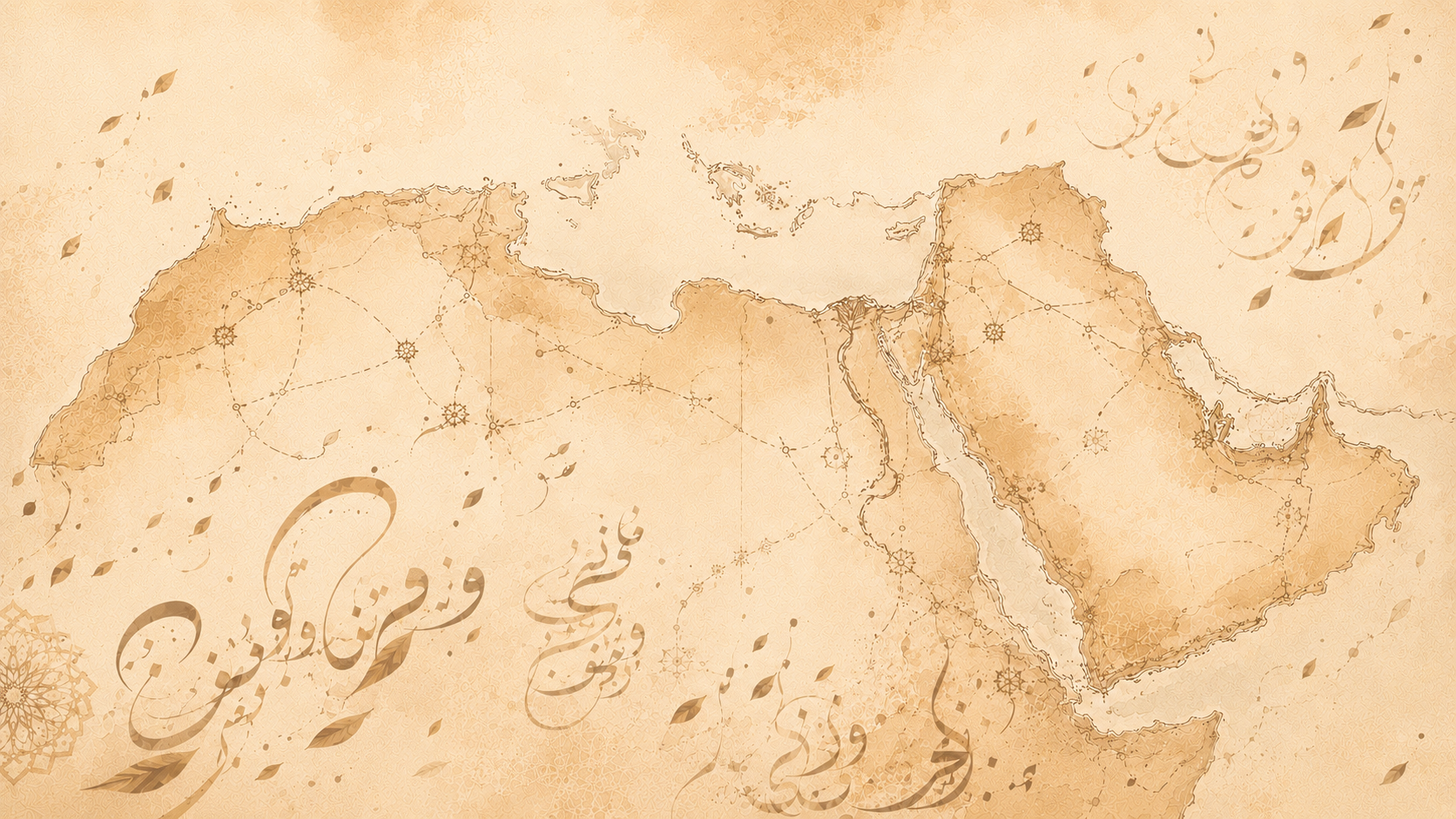
On the question that opens every Arabic learner's path, often before they know they are facing it. The textbook calls it Arabic. The reality is more interesting.
There is a convenient fiction at the center of most Arabic instruction: that Arabic is one language, learnable from one book, the same in Casablanca as in Cairo, the same in Cairo as in Beirut, the same in Beirut as in Baghdad. It is a useful fiction, the kind that makes a syllabus possible and a curriculum tidy. It is also not quite true.
A learner who studies Arabic from a standard textbook will encounter a clean, formal language — verbs that conjugate predictably, vocabulary that is shared across the Arab world, phrases that any educated speaker will recognize. The learner will not, in most cases, be told that this Arabic is the Arabic of newspapers, of broadcasts, of speeches, and of books, and that almost no one speaks it at home. The learner will not be told, or will be told only in passing, that what people in Egypt speak in their kitchens, what people in Lebanon speak with their children, what people in Morocco speak in the souk, is not the Arabic of the textbook but a different Arabic — and that there are several of these different Arabics, and that each is its own thing.
This is the first piece on a site about spoken Arabic, and it has to begin here, because everything else depends on it.
The technical name for the situation is diglossia. The term, borrowed from Greek and applied first to Arabic in a now-classic 1959 paper by the linguist Charles Ferguson, describes a stable arrangement in which two related but distinct varieties of a language coexist in the same community, each occupying its own social space.
In Arabic, the two varieties are al-fuṣḥā — "the most eloquent," the formal register — and al-ʿāmmiyya — "the common," the colloquial. Al-fuṣḥā in its modern form is what we call Modern Standard Arabic. It is what anchors news broadcasts, what fills the pages of literary fiction, what is recited from the Quran across the world. Al-ʿāmmiyya, on the other hand, is what people actually speak. It is what a Cairo grandmother uses with her grandchildren, what a Beirut shopkeeper uses with a customer, what two Casablanca friends use over coffee.
The arrangement is stable because each variety has its assigned domain. No one writes a newspaper editorial in al-ʿāmmiyya. No one orders dinner in al-fuṣḥā. The speakers move between the two without thinking about it, the way speakers in many languages move between formal and casual registers — but the gap between al-fuṣḥā and al-ʿāmmiyya is wider than the gap between formal and casual English, and crossing it requires switching not just word choice but pronunciation and grammar.
For the learner, the consequence is immediate. The Arabic of the textbook and the Arabic of the street are not the same. A student who has learned only al-fuṣḥā and arrives in Cairo for the first time will discover, often within minutes, that what they hear bears only an oblique relationship to what they have studied.
The historical reason for the arrangement is worth knowing, because it explains why the gap is what it is.
Classical Arabic — the Arabic of the Quran, of the early Islamic poetry, of the great medieval writers — was the prestige language of a vast civilization that, by the eighth and ninth centuries, stretched from the Atlantic coast of Morocco to the borders of India. It was the language of religion, of administration, of literature, of science. It was learned and used by the educated classes wherever Islamic civilization reached.
But the people who lived under that civilization — most of them, for most of the history — did not speak Classical Arabic in their daily lives. They spoke the local Arabic of their region, which over centuries diverged in different directions in different places. The Arabic of Egypt absorbed Coptic substrates. The Arabic of the Maghreb absorbed Berber. The Arabic of Iraq absorbed Aramaic and later Persian and Turkish. The Arabic of the Levant absorbed Aramaic and Greek. By the time the medieval period ended, the spoken Arabics of these regions had drifted apart enough that a speaker of one could not always understand a speaker of another.
What held the Arab world together linguistically was the prestige of Classical Arabic, preserved through the religious and literary traditions, and through the careful schooling of the educated classes. Spoken Arabic could drift. Classical Arabic stayed put. Modern Standard Arabic — al-fuṣḥā in its twentieth-century form — is the modernization of the Classical, with a vocabulary updated for telegraphs and parliaments and microchips, but with a grammar that has changed remarkably little since the eighth century.
This is why the diglossia is what it is. The formal register did not evolve with the spoken; it was preserved. The spoken evolved into many regional varieties, free of the gravitational pull that would have kept them close. And so the modern Arabic-speaking world consists of one shared formal register, descended directly from the Quran, and many spoken vernaculars, each shaped by its own history and geography.
The major spoken varieties — the ones a learner will encounter, choose among, or have to choose among without realizing — are roughly the following.
There is Egyptian Arabic — Maṣrī — spoken by more than a hundred million people in Egypt and understood widely across the Arab world due to the cultural reach of twentieth-century Egyptian cinema, music, and television. There is Levantine Arabic — Shāmī — spoken across Syria, Lebanon, Palestine, and Jordan, and rivaling Egyptian in its current media presence through the musalsalāt, the high-production pan-Arab dramas. There is Gulf Arabic — Khalījī — spoken across Saudi Arabia, the United Arab Emirates, Kuwait, Qatar, Bahrain, and Oman, increasingly heard on television and in business as the Gulf rises in regional influence. There is Maghrebi Arabic — Darija — spoken across Morocco, Algeria, Tunisia, and Libya, and the most distinct of the spoken varieties, with heavy Berber and French influence, often unintelligible to Eastern Arabic speakers without practice. There is Iraqi Arabic, with its layered vocabulary inherited from Aramaic, Persian, and Turkish. There is Sudanese and there is Yemeni, each with its own histories and its own striking features, though more rarely encountered by learners.
These are not minor variations. The differences in pronunciation, in vocabulary, in grammar, in the small particles that fill ordinary speech, are large enough that mutual intelligibility cannot be assumed. A Moroccan and a Saudi who meet for the first time will often shift toward Egyptian or al-fuṣḥā to find common ground, the way speakers of different European languages will sometimes meet in English. The shared inheritance is real. The local divergence is also real.
A more detailed map of these varieties — what each sounds like, where it is spoken, who tends to learn it — lives on the Dialects page of this site, and individual studies of each will appear in time.
What does this mean for a learner?
The first thing it means is that the question "should I learn Arabic" cannot be answered without a follow-up question, which is "which Arabic." A learner who does not face this question explicitly will face it implicitly, by way of the course they choose, the textbook they buy, the teacher they hire — each of which will quietly settle the question in some direction. The decision will be made. The only choice is whether to make it consciously.
The second thing it means is that the learner has to think about what they want the language for. A learner whose interest is in reading — Arabic literature, the news, classical poetry, the Quran — should begin with al-fuṣḥā, because al-fuṣḥā is the written language of the Arab world and the spoken dialects rarely appear in print. A learner whose interest is in speaking with people in their daily lives — friends, neighbors, a partner, the people of a particular city — needs a spoken dialect, and the dialect should be the one of the place they care about. A learner who wants both, eventually, will need to study both, and most committed Arabic learners do.
The third thing it means is that the choice of dialect is consequential but not permanent. Egyptian travels well across the Arab world, because most Arabs have grown up with Egyptian media and can adjust their ear to it. Levantine also travels well. Darija travels less well, in the eastward direction, but is essential for North Africa. Khalījī is most useful for the Gulf. A learner who begins with one dialect and later finds themselves living in a region that speaks another will adjust, with effort but without starting over. The foundation of one is a foundation that carries.
The final thing — and this is perhaps the most important — is that the learner should not be discouraged by the situation. Arabic is not unique in having dialects. English does too, though the English-speaking world tends to underestimate this fact because the English dialects are mutually intelligible enough that a single textbook serves the whole. Arabic differs not in the existence of its dialects but in the size of the gap between them and in the existence of a separate formal register that no one speaks at home. The situation is more complex than the textbook makes it appear. It is not, however, untraversable.
There is a broader observation worth ending on.
The textbook fiction of "Arabic" — the implication that what is taught in the course is the Arabic, and that there is no other Arabic worth knowing about — is a fiction of convenience. It is not a fiction of malice. Curricula must simplify. Courses must choose. A student who has only sixteen weeks cannot be sent simultaneously into al-fuṣḥā and into five regional dialects. The textbook does what textbooks must.
But the learner does not have to remain inside the textbook's simplification, and after the first months, they should not. The Arab world is not one country with one variety of one language. It is many countries with many varieties of a language that is shared at the formal register and richly diverse at the spoken one. To learn Arabic, in any meaningful long-term sense, is to enter a world of many Arabics — to choose one as a starting point, to know the others exist, and over time to learn how the one connects to the rest.
The fiction is convenient. The reality is more interesting.
— A.C. Maas